30/01/2026
Marina Leal
The Revolution No One's Talking About:
How Africa Is Quietly Rewriting Tomorrow's Playbook
Here’s what they won’t tell you on the evening news: while the world fixates on chaos, an entire continent is busy building the future the rest of us are still arguing about.
I’m talking about Africa. And no — this isn’t another poverty-porn narrative or a “save the continent” plea. This is about something far more disruptive: a wave of innovation, grassroots action, and structural transformation that’s happening right now, in places you’ve probably never heard of, by people whose names won’t trend on Twitter.
And here’s the thing that keeps me up at night: we’re not paying attention.
The Stories That Slip Through the Cracks
(And Why That's Dangerous)
Let me paint you a picture.
In Mauritania, in the ancient desert city of Chinguetti — a UNESCO World Heritage site where families strive to protect medieval manuscripts that gather dust in crumbling ancient libraries — something extraordinary is unfolding. The local community isn’t just preserving history; they’re building futures. Through the Linguistic and Tourism Bridging Project, they’re creating a cultural tourism circuit that transforms how local communities see themselves and how the world sees them.
Think about that for a second. In a place where time seems to stand still, where economic opportunity feels like a distant mirage, a group of determined locals decided:
They’re training young guides. Which in the end could mean: Restoring ancient sites. Building infrastructure. Creating posible jobs where there were none. And they’re doing it with the kind of patient, deliberate action that doesn’t make headlines but changes everything.
Now, zoom out to Senegal. In the Casamance region, Campamentos Solidarios is running solidarity camps that flip the script on “voluntourism.” This isn’t about Westerners taking selfies with African children. This is about cultural exchange that actually means something — where European youth work alongside Senegalese communities on real infrastructure projects: digging wells, building classrooms, creating gardens. The kind of work that leaves both sides transformed.
Here’s where it gets interesting: these aren’t isolated feel-good stories. They’re part of something bigger.
The Invisible Thread Connecting Everything
While Mauritania preserves heritage and Senegal builds bridges between cultures, Africa just opened its first AI factory. Yes, you read that right. An entire facility dedicated to artificial intelligence infrastructure — not in Silicon Valley, not in Shenzhen, but in Africa.
And in case you think that’s a fluke, consider this: African tech startups raised $2.89 billion in January 2025 alone. That’s not a typo. Nearly three billion dollars, in one month, flowing into African innovation.
Or how about this: the OECD projects that increasing annual infrastructure investment by just $155 billion could double Africa’s GDP by 2040. Double. In fifteen years.
See the pattern? Small cultural tourism project in Mauritania. Youth exchange camps in Senegal. Billion-dollar AI factories. Exponential economic growth projections.
They’re all part of the same story: the story the media doesn’t focus on.
When Hope Isn't Just a Feeling
— It's a Strategy
Let me take you deeper.
In Liberia, a country still healing from civil war, the Hermanas Hospitalarias del Sagrado Corazón de Jesús runs the Aita Menni psychiatric hospital in Monrovia. Mental health care in post-conflict West Africa? That’s not just healthcare — that’s nation-building. Through the We Are Like You project, they’re treating patients others have given up on, training local staff, and proving that dignity doesn’t stop at the clinic door.
Meanwhile, in Ethiopia, Proyecto Visión is tackling something as fundamental as sight. In a country where preventable blindness keeps thousands locked out of economic participation, this initiative provides eye care that literally opens new worlds. Cataract surgeries. Eyeglasses. Vision screenings in rural communities. It sounds simple until you realize: one person’s restored sight means one more child educated, one more farmer productive, one more family lifted.
Now, here's where the story gets wild.
Egypt just emerged as Africa’s leader in AI readiness for public administration. The same continent where NGOs are doing eye surgeries by lamplight is also leading the charge in artificial intelligence governance.
The Tony Elumelu Foundation has generated $4.2 billion in revenue through its entrepreneur support programs. Four point two billion. From startups that didn’t exist a decade ago.
African nations are transitioning from a linear economy to a circular one, pioneering sustainability models the West is still debating.
Connect the dots. Mental health care in Liberia. Eye surgeries in Ethiopia. AI governance in Egypt. Circular economy transitions. Billions in entrepreneurship revenue.
This isn’t charity. This is transformation at scale.
The Double Play: Guinea-Bissau and Burkina Faso (Or: How Two Tiny Countries Are Doing Things Brilliantly)
Let’s land in Guinea-Bissau, one of the world’s smallest and least-talked-about nations.
Here, CBD-Habitat isn’t “building” Guinea-Bissau with imported solutions—it’s activating a conservation-and-employability model from the ground up in the Bijagós Islands. Funded by Fundación Europamundo in 2025, the project uses the Orango Parque Hotel as a hub to launch micro-projects that protect mangroves and national parks—while also rallying action to save the monk seal. And the smartest part is that the impact doesn’t end with visitors: the hotel provides continuous training so local workers—especially young people—can become qualified professionals in the emerging ecotourism sector (guest services, tourism careers, and guiding), and stay on the islands with decent work. At the same time, hotel income is reinvested into practical community projects (such as education initiatives, drinking-water wells, and infrastructure improvements) and into skills programs that expand employability and household income.
 At the same time, in Burkina Faso, Project Policía Amigo is rebuilding trust between law enforcement and communities. Think about that challenge: in a country with a history of instability, making police officers into allies of the neighborhoods they serve. Backpacks with school materials for children, training programs, community dialogues, youth engagement. It’s slow, unglamorous work. It’s also the foundation of every functioning society.
And while Guinea-Bissau quietly builds homes and Burkina Faso rebuilds trust, guess what’s happening elsewhere on the continent?
Google just launched its 2025 Accelerator Program for African startups, backing everything from AI-powered agricultural tech to fintech platforms serving the unbanked.
Cape Verde inaugurated a cutting-edge technology and innovation hub, positioning itself as a tech gateway between Africa, Europe, and the Americas.
Foreign Direct Investment in Africa grew 7% despite global FDI declining 11%. Read that again. While the world economy contracts, Africa expands.
Our projects are drops in an ocean
You might be wondering: why is Fundación Europamundo writing about Google’s accelerator program and Cape Verde’s tech hub when it’s funding eye clinics in Ethiopia and housing projects in Guinea-Bissau?
Here’s why, and it’s the most important thing I’ll say in this entire piece:
No one does this work alone.
Every September, Fundación Europamundo opens a call for proposals. Small NGOs, community associations, grassroots organizations — they submit projects addressing real problems in overlooked communities. A handful gets funded. In 2025, projects were supported in Mauritania, Senegal, Liberia, Ethiopia, and Guinea-Bissau — and in Asia and Latin America.
But here’s what one understand that the despair-industrial-complex doesn’t: our projects are drops in an ocean. Beautiful, necessary drops — but drops nonetheless.
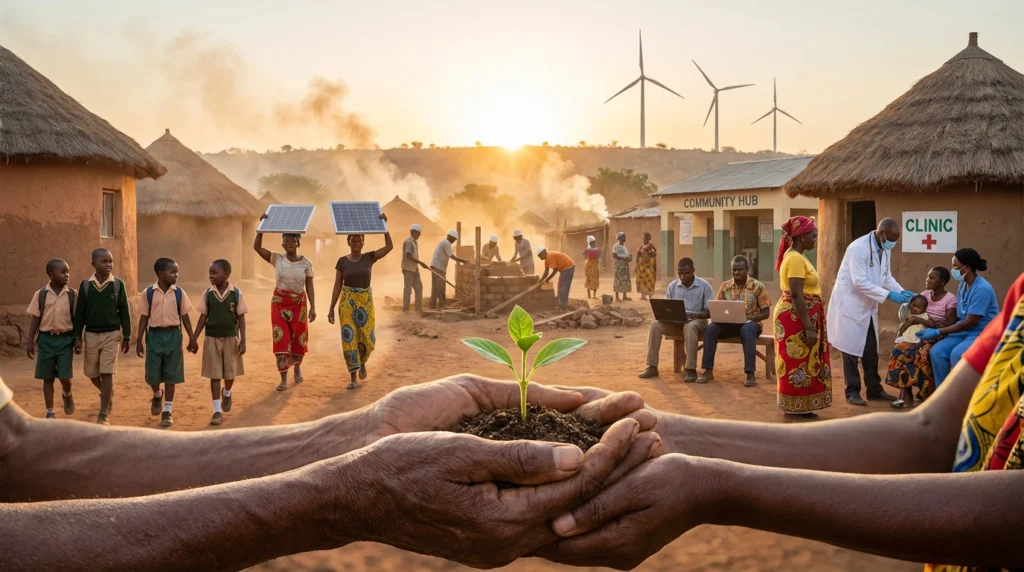
The ocean itself is made of millions of these drops.
The nuns treating mental health patients in Monrovia. The engineers building AI infrastructure in Cairo. The entrepreneurs in Lagos, Nairobi, Accra, and Kigali who just raised $2.89 billion. The policymakers designing circular economies. The teenagers in Senegal digging wells alongside European volunteers. The police officers in Guinea-Bissau learning to serve instead of intimidate.
Every single action amplifies the others. The tech startup that succeeds creates jobs for people who got education from an NGO-funded school. The sustainable housing project uses materials from a cooperative launched by a micro-finance initiative. The restored tourist site in Mauritania becomes a case study for cultural preservation efforts across the Sahel.
And here’s the part that keeps me going: every time we report on these stories — all of these stories, not just our own — we’re doing something radical.
We’re refusing to let despair win.
The Economics of Hope (Or: Why Good News Isn't Naive, It's Strategic)
Let me get real with you about something.
Despair is expensive. Fear is paralyzing. Hopelessness is economically catastrophic.
When people believe there’s no future, they don’t invest in education. They don’t start businesses. They don’t plant trees they won’t live to see mature. They don’t build institutions. They don’t dream.
Entire nations have collapsed under the weight of collective despair.
But hope? Hope is a different beast.
Hope makes a person in Chinguetti think: “Maybe I can become a tour guide”. And suddenly, you have a youth investing in language skills, in cultural knowledge, in showing up day after day to build something.
Hope makes a community in Guinea-Bissau think: “Maybe we can build our own homes”. And suddenly, you have collective action, skill-sharing, people teaching their children that they’re not powerless.
Hope makes an entrepreneur in Nairobi think: “Maybe this AI solution can solve supply chain problems across East Africa”. And suddenly, you have a startup raising capital, hiring staff, disrupting markets.
Hope isn’t naive. Hope is the most pragmatic force in human development.
And that’s why we tell these stories. Not to pat ourselves on the back. Not to pretend everything is perfect. But to demonstrate, with evidence, with data, with real projects and real results, that change is not only possible — it’s already happening.
The Fund That Runs on Passenger Power
Here’s how Europamundo Foundation (Fundación Europamundo) works, because I think you should know.
The foundation’s parent company, Europamundo Vacations (Europamundo Vacaciones), runs tours across Europe. Thousands of passengers every year. And for every single passenger, the company allocates €2.25 to the foundation.
Two euros and twenty-five cents. The cost of a coffee.
Multiply that by hundreds of thousands of passengers, and suddenly there’s funding for eye surgeries in Ethiopia, cultural tourism training in Mauritania, solidarity camps in Senegal, housing projects in Guinea-Bissau, and mental health care in Liberia.
From tourism, for transformation.
But the money is almost the least interesting part. Because what really happens is this: people who are traveling for pleasure are connected — through that small contribution they might not even know they’re making — to communities they’ll never meet, in countries they might never visit, addressing problems they might never see.
Invisible threads are built across continents. It’s shown that commerce and compassion aren’t opposites. And it’s proven that every transaction can be a transaction plus — plus education, plus healthcare, plus opportunity, plus hope.
And then the stories get told. Not just the projects supported by Fundación Europamundo, but the entire ecosystem of change. Because transformation doesn’t belong to any one organization. It belongs to all of us.
What Happens When You Choose to See Differently
I started this piece by saying Africa is quietly rewriting tomorrow’s playbook. Let me be more specific about what that means.
Africa is pioneering models the rest of the world will eventually adopt because it has to. When you can’t rely on legacy infrastructure, you leapfrog straight to mobile money. When you can’t import everything, you innovate with local materials. When you can’t afford waste, you design circular systems from the ground up.
The cultural tourism in Chinguetti?
That’s community-owned economic development.
That’s community-owned economic development.
The solidarity camps in Senegal?
That’s intercultural collaboration at its most authentic.
That’s intercultural collaboration at its most authentic.
The mental health care in Liberia?
That’s post-conflict healing done right.
That’s post-conflict healing done right.
The eye surgeries in Ethiopia?
That’s preventative healthcare as poverty alleviation.
That’s preventative healthcare as poverty alleviation.
The housing in Guinea-Bissau? That’s sustainable urbanism.
The community policing in Guinea-Bissau?
That’s participatory governance.
That’s participatory governance.
And when you step back and see it all together — the grassroots projects, the billion-dollar startups, the AI factories, the circular economies, the infrastructure investments — you realize:
This is what resilience looks like. This is what innovation looks like. This is what the future looks like when it’s built from the ground up instead of imposed from the top down.
The Invitation You Didn't Know You Needed
So here’s where I land: if you’re exhausted by bad news, if you’re tired of doomscrolling, if you’re hungry for evidence that humans are still capable of solving problems instead of just creating them:
Pay attention to Africa!
Not because it’s perfect. Not because there aren’t still massive challenges. But because it’s where some of the most creative, determined, innovative problem-solving on the planet is happening right now, often in places the media will never cover.
Follow the stories. Support the work. Question the narrative you’ve been sold.
And if you want to stay connected to these stories — the ones that slip through the cracks, the ones that don’t make the evening news, the ones that prove despair doesn’t have to win — we’re building that community.
Subscribe to our newsletter on LinkedIn or on our website to get these stories delivered straight to your inbox.
Because here’s the truth: the revolution isn’t televised. But it is documented. It is measurable. It is real.
And the more of us who see it, the faster it spreads.
Sources & Further Reading:
- Las Startups Tecnológicas Africanas Recaudan $2.89 Mil Millones en Enero de 2025
- África Inaugura su Primera Fábrica de IA
- OCDE: La Inversión en Infraestructura Podría Duplicar el PIB de África para 2040
- Egipto Lidera África en Preparación de IA
- La Fundación Tony Elumelu Genera $4.2 Mil Millones en Ingresos
- La Transición de África a la Economía Circular
- Google for Startups Accelerator: África 2025
- La IED en África Crece a Pesar de la Caída Global
- Inteligencia Artificial: Fuerza Motriz para el Cambio en África
Categories
Latest Posts

January 30, 2026
The Revolution No One’s Talking...
April 15, 2025
Travel transforms: this is how we change...Archive
Tags